Metrics
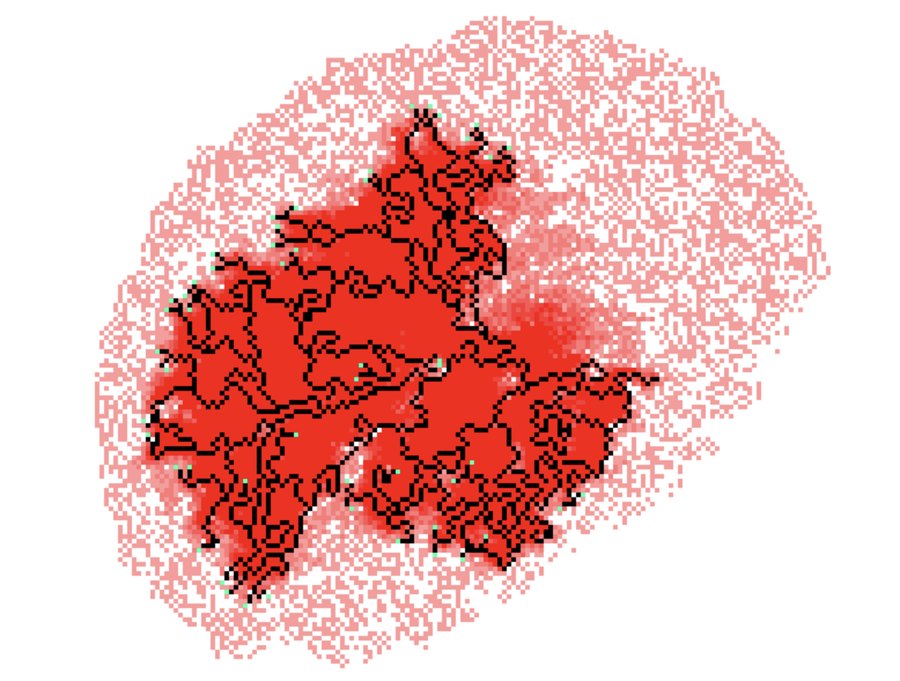
90 connected regions threshold 164 edge density 0.1196
1. Foreground candidates
The dark-region segmentation is not assumed to be “the object.” It is only one possible reading of figure. In Alexander terms, a region becomes interesting only when it acts as a center and helps other centers.
2. Background as possible positive space
The light-region segmentation is equally important. This is where the system starts to ask whether so-called empty space has its own shape, convexity, swelling, and coherence.
3. Boundaries and edge field
Boundaries are not treated as dimensionless lines. The current proxy is only an edge field; later versions should estimate thick transition zones.
4. Candidate centers
Bounding boxes and centroids are crude, but useful. They show where the system believes coherent regions might be. The next phase should allow hand correction.
5. Levels of scale
The histogram groups component sizes into octave-like bins. A living structure should rarely jump from enormous to tiny without intermediate centers.
What this report cannot yet know
This is not a beauty detector. It is a first operationalization of several Alexander-like geometric proxies.
Positive space is approximated by the quasi-convexity and coherence of background regions, not by empty background alone.
The next real phase is calibration: pairwise human judgments and hand-corrected center diagrams.