progress report 0–2

From proposal to first deployable instrument

This report explains what has been built before the first deployment: not a final recognizer of living structure, but an App Engine-compatible instrument for seeing where such a recognizer could become precise.

Back to app

Phase 0: a practical architecture

The first change from the earlier proposal is practical: the system is designed as a three-tier Google App Engine app. The browser handles upload and reports. Flask performs analysis. Datastore stores the compressed image, metrics, SVG diagnostics, and report.

Phase 1: explicit geometry, not hidden judgment

The analyzer uses ordinary image operations: grayscale conversion, thresholding, connected components, edge maps, bounding boxes, centroids, and simple shape scores. Every number has a visible diagram attached to it.

Phase 2: first Alexander-like proxies

The first metrics correspond to relatively operational properties: centers, levels of scale, positive space, boundaries, roughness, and local symmetries.
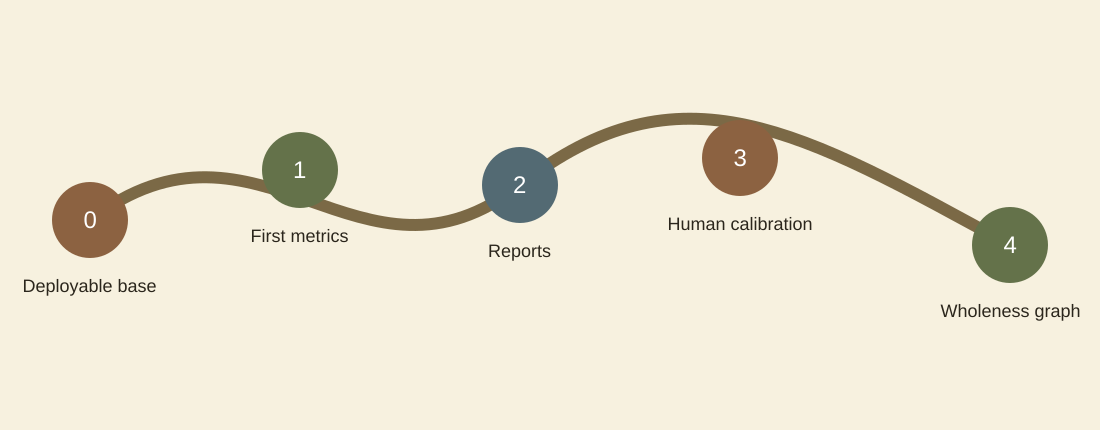
The first deployment should happen after phases 0–2 so real images can start exposing failures.

The honest status

This version is a measuring instrument, not a finished theory. The wholeness score is deliberately labeled “initial.” Its purpose is to make disagreements visible. When it calls a dead space positive, or misses a living space between branches, that failure becomes data for the next phase.

What is strong enough to deploy

Upload, downscale, analyze, store, render reports, and inspect the first center/space diagrams.

What comes next

Human pairwise comparison, hand-corrected center diagrams, image categories, calibration sets, and better positive-space geometry.